
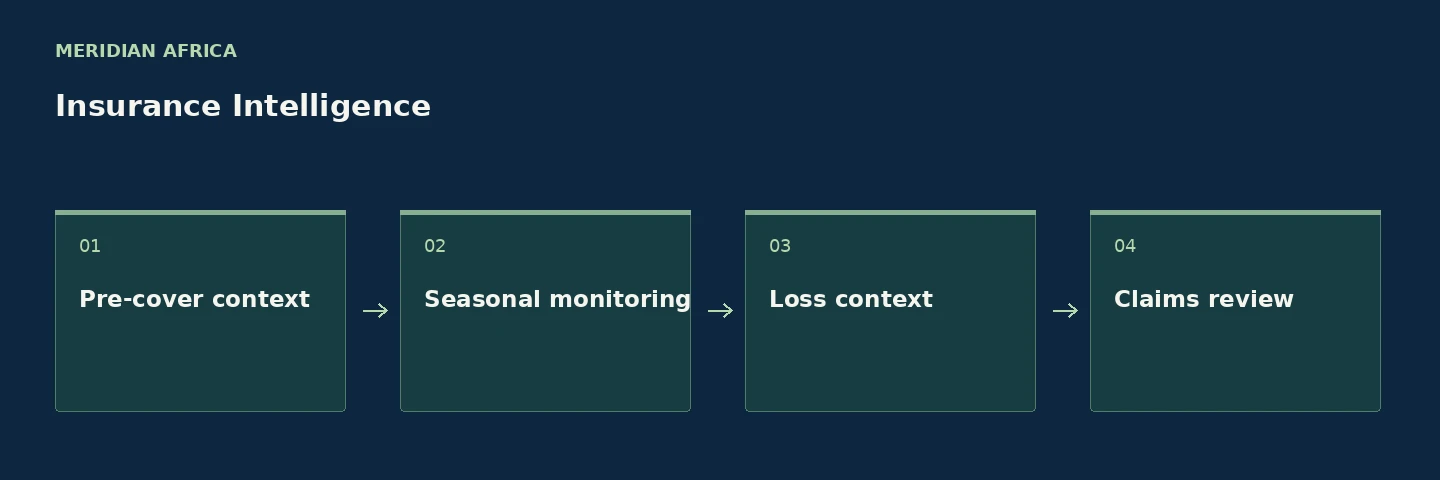
01
Pre-cover context
Examine land use, production history and environmental exposure where data permits.
SECTOR 03 / INSTITUTIONAL AGRICULTURAL INTELLIGENCE
Agricultural insurers need to understand the exposure they take on, conditions as the season develops and the context surrounding a reported event. Meridian provides dated physical observations for review at each stage.
LANDSCAPE / INSTITUTION / DECISION
01 / Institutional responsibility
Insurance teams define cover, manage accumulated exposure and assess reported losses under their policy terms. The physical history of a location can help frame a question, but it must be read alongside declarations, policy wording, weather records and field investigation.
02 / Visibility problem
Declared acreage and crop information may be incomplete. Weather events affect fields unevenly, and a post-event visit may not show what conditions were before the event. At portfolio scale, claims teams need to prioritise investigations without prejudging individual claims.
The question is what the physical evidence adds to the institution’s existing record.
03 / Applications
01
Examine land use, production history and environmental exposure where data permits.
02
Follow weather and vegetation conditions across insured geographies.
03
Place a reported event in its local timing and spatial context.
04
Identify cases where additional field evidence may be most useful.
04 / Working method
Agree locations, period, crops where known and relevant policy context.
Review historical and pre-event conditions available for the area.
Compare weather and production signals before and after the reported period.
Provide dated context for the insurer’s own investigation and decision.
05 / Institutional outcomes
Bring physical history into underwriting and portfolio discussion.
Direct field assessment to cases with meaningful questions.
Keep temporal and geographic context available for review.
07 / Evidence boundaries
WHAT THIS EVIDENCE DOES NOT DETERMINE
A satellite or weather signal does not prove an insured peril, quantify an individual loss or determine policy liability. Resolution, timing, crop practices and other causes matter. Underwriting and claims decisions remain with the insurer under its policy and evidentiary processes.
DISCUSS YOUR INSTITUTIONAL QUESTION
Share the geography, assets and decision context. We can discuss what physical evidence is available and how it would be validated.