↗
Processor feedstock
Monitor conditions in production areas serving processing facilities.
CAPABILITY 04 / INSTITUTIONAL AGRICULTURAL INTELLIGENCE
How does agricultural production risk travel beyond the farm gate?
The condition of a sourcing landscape matters to aggregators, processors, storage networks and exporters. Meridian links upstream production context to the downstream assets and commitments that depend on it.
OBSERVATION / CONTEXT / DECISION
01 / Institutional problem
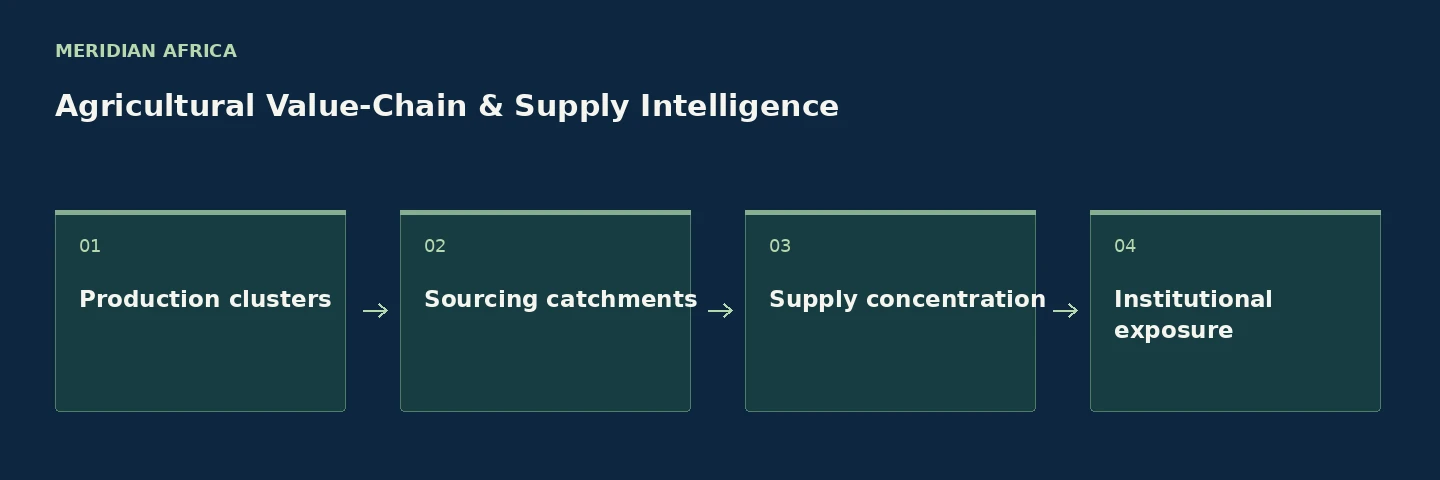
A processor may know its contracted volumes but have limited visibility into the areas expected to supply them. A warehouse operator may know its catchment but not how the season is developing upstream. Geographic concentration can make a local shock matter across several stages of the value chain.
02 / Meridian capability
Meridian maps sourcing zones, production clusters, catchments and corridors against available agricultural, weather and land-use observations. This helps teams identify concentration, change and potential supply exposure for targeted commercial and field review.
The objective is not more maps. It is better decisions.
03 / Working method
Each engagement starts with a decision context. Observations are interpreted and reviewed before an institution acts.
Define sourcing zones, facilities, clusters and relevant corridors.
Review production and environmental conditions across the catchment.
Relate upstream signals to downstream dependencies and concentration.
Compare findings with procurement, logistics and field evidence.
04 / Applications
↗
Monitor conditions in production areas serving processing facilities.
↗
Understand cluster condition and geographic concentration.
↗
Place warehouse demand in its upstream production context.
↗
Examine land-use history and sourcing-area exposure.
05 / Institutional value
Look beyond contracted volumes to the landscape supplying them.
See where dependencies gather in one area or corridor.
Help sourcing and operations teams decide what to investigate.
06 / Limits & governance
WHAT THE EVIDENCE CAN AND CANNOT ESTABLISH
A production signal does not prove a shipment’s origin, available inventory, warehouse bag count, commodity quality or a future delivery volume. These need transaction records, chain-of-custody evidence, physical inspection and other controls. Meridian provides geographic and production context for those processes.
START WITH YOUR QUESTION
Tell us about the assets, geography or programme you need to understand. We can discuss the evidence available and what further validation would require.